The most memorable dining experiences cannot be defined by a single element. While quality food and service remain paramount, growing competition in the food and beverage industry and diners’ preference for visually compelling restaurants have introduced an emphasis on how the entire experience unfolds from the moment guests arrive to the moment they leave. This understanding of the current landscape helped drive the designs for Ramsay’s Kitchen at Harrah’s Valley River and the Gordon Ramsay Food Market at Harrah’s Cherokee Casino Resort, where a series of connected experiential moments creates a continuous guest journey rather than a singular focal point.
Experience as the New Competitive Edge
Today, restaurants face competition from one another in addition to the convenience of staying home, where delivery services provide an easy alternative. Guests are more intentional about where they spend their time and attention, prioritizing atmosphere, narrative, and immersion over function alone. To draw guests out of their homes, restaurants need to provide a distinct experience and atmosphere that cannot be replicated elsewhere.
Designing experiential dining environments comes with challenges that require creative solutions, as project teams are tasked with shaping perception and movement within existing architectural conditions. In the case of Ramsay’s Kitchen, the 12th-floor location and single elevator entrance create a vertically constrained arrival sequence with limited opportunities for gradual transitions. In response, the exhibition kitchen and main dining areas are strategically placed within view of the elevator arrival, with the layout opening toward framed mountain vistas to orient guests and build anticipation.
The arrival experience, once incidental, is now deliberately choreographed to set the tone. That narrative continues throughout the restaurant, expressed through spatial cues such as thresholds, material transitions, and subtle shifts in scale and lighting. Together, these elements intuitively guide movement and help guests understand how to engage with the space while reinforcing a sense of place and identity.
Immersive Dining Through Visibility
A key component of experience-driven design is visibility into the culinary process. Open kitchens, in particular, dissolve the traditional boundary between guest and chef, transforming food preparation into an integral part of the experience. Rather than concealing the work behind the scenes, they bring it forward, making it visible, dynamic, and engaging.
When thoughtfully integrated, the kitchen becomes a visual anchor, an active and ever-changing focal point that grounds the space without overwhelming it. Carefully composed sightlines allow guests to engage with the rhythm of service, reinforcing a sense of energy and immediacy. This transparency adds a layer of authenticity, inviting diners to connect with the craft in real time. Observing the coordination, timing, and precision behind each dish strengthens the relationship between execution and experience, making the kitchen and dining room feel like inseparable parts of the same moment.
Atmosphere as the Framework for Experience
As visibility increases, the atmosphere takes on an even greater role. It acts as the connective tissue that brings together materiality, sound, lighting, and activity into a cohesive environment. A well-designed atmosphere shifts seamlessly between moments of energy and calm, creating a rhythm that supports the overall dining experience.
The arrival sequence, in particular, should do more than welcome. It should transport. Guests should feel a clear departure from the ordinary the moment they cross the threshold. This sense of transition anchors the experience before a single dish is served and sets expectations for what is to come.
At Ramsay’s Kitchen at Harrah’s Cherokee Valley River, that sense of anticipation is built through a carefully choreographed entry. Accessible only via elevator, the journey culminates in a dramatic reveal. Doors open into a vestibule layered with bold finishes and oversized brand graphics. This intentional pause point invites guests to engage, orient themselves, and capture the moment, extending the experience into the digital realm. The design evokes the feeling of box seats at a theater, formal, immersive, and exclusive, setting the stage for what follows.
These threshold moments are critical. They establish tone, signal exclusivity, and create an emotional shift from exterior to interior. When executed well, the entrance becomes an immersive prelude to the dining experience rather than a simple point of access.
A successful restaurant also incorporates a distinct moment of surprise and delight, a wow factor that feels intentional and rooted in the brand narrative. At Gordon Ramsay Food Market, this takes the form of a large-scale installation, a 15-by-30-foot composition of vividly colored plates arranged into a Union Jack. More than decoration, it serves as a visual anchor and a natural gathering point, drawing guests in and encouraging interaction.
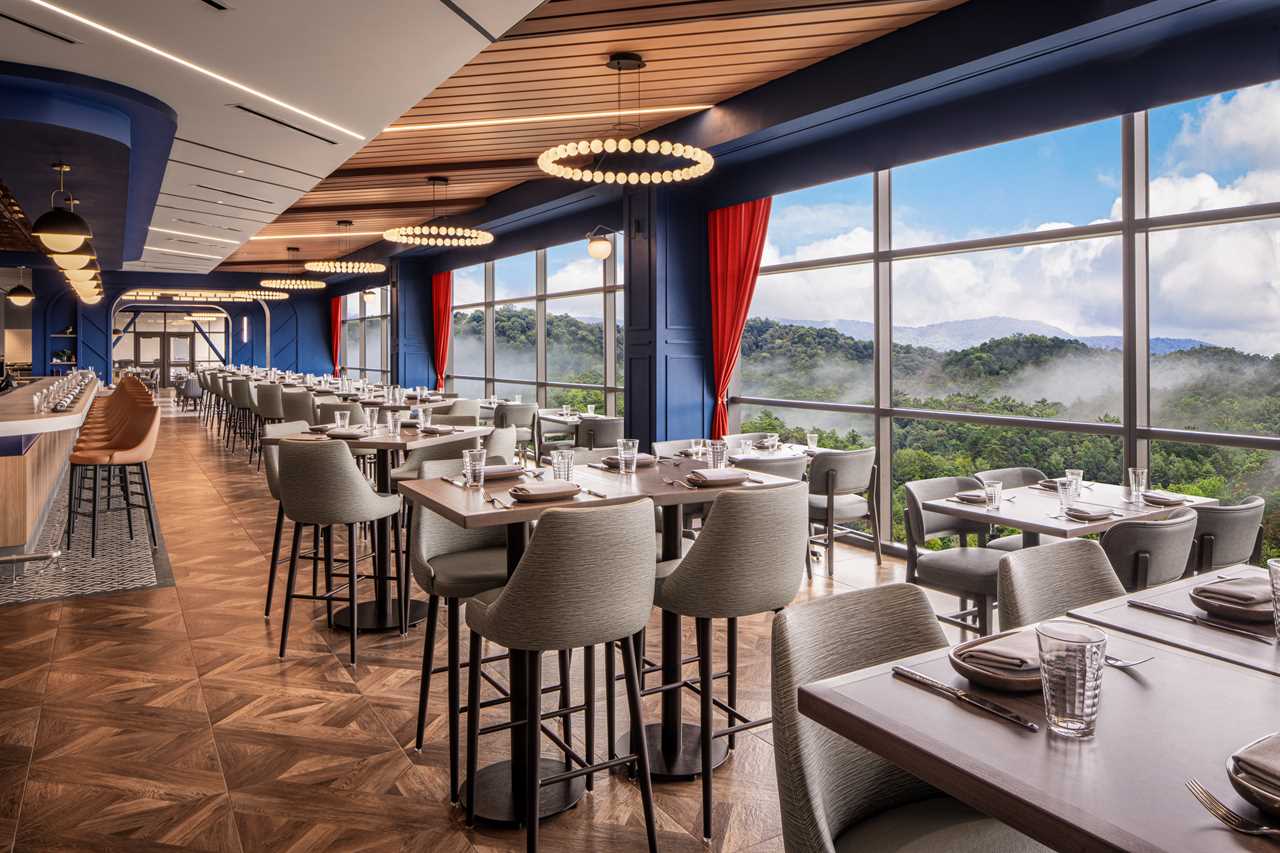
Photo by Tory Kooym
At Ramsay’s Kitchen, the impact is more spatial and experiential. The rooftop setting is leveraged through carefully framed views, with each window bay treated as an intimate stage. Vibrant drapery introduces rhythm and contrast, while seating is oriented to maximize sweeping views of the Nantahala Forest and surrounding mountains. The result is a series of curated vantage points that feel both expansive and personal, reinforcing a strong connection to place.
The rooftop terrace extends this experience even further. Lounge seating, integrated shading systems, and a thoughtfully developed cocktail program encourage guests to linger, layering the experience beyond the dining room and reinforcing a sense of destination.
Designing for Memory and Shareability
This attention to composition extends beyond the physical space into how the experience is remembered and shared. In an era shaped by social media and digital storytelling, restaurants must perform both in person and on screen. Moments are no longer fleeting. They are captured, curated, and shared widely.
Design decisions are increasingly evaluated for how they translate visually, how moments are framed, and how they resonate beyond the immediate experience. Key touchpoints must hold their impact even when removed from the full sensory environment, shaping how the experience is recalled through imagery and memory.
Ultimately, what defines today’s most compelling dining environments is not a single design gesture, but the way multiple layers work in concert. From visibility into the kitchen to the structuring of atmosphere, and from arrival sequences to moments of surprise, each element contributes to a cohesive system where execution, perception, and environment are deeply intertwined. It is within this interplay that restaurant design moves beyond backdrop and becomes an essential part of the experience itself.
Top photo: Gordon Ramsay Food Market by Robert Benson Photography